
Commission Schmamission
Just because you sign an executive order and establish a fancy schmancy commission does not mean you actually care about military spouses.

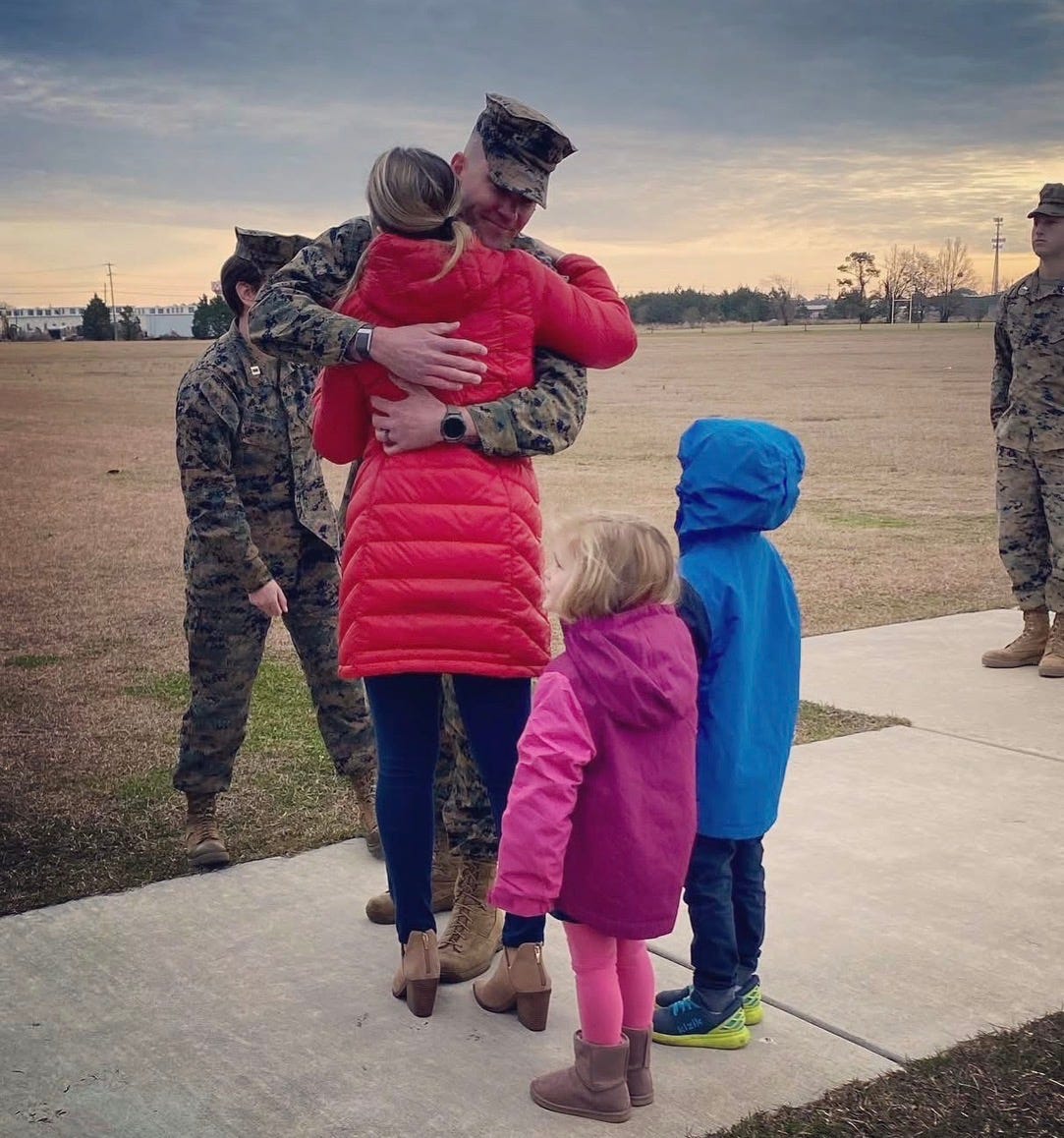
Let me preface this by saying I don’t think any administration—Republican or Democrat—has ever truly cared about military spouses. “If the military wanted you to have a spouse, they would have issued you one,” is still the predominant mindset among a large enough subset of government and military leadership that it’s taken until 2026 to even propose a spouse commission.
This mindset continues to be directly reflected in the DOD budget, which has shifted significantly over the last several decades from Personnel, to Operations and Maintenance (O&M), and Research, Development, Test, and Evaluation (RDT&E).
And in the absence of adequate, reliable support, resources, and funding for policies and programs that benefit quality of life for service members, who do you think fills in the gaps?
Why, the military spouse, of course.
It is astonishing to me that the stereotype of the military spouse as a lazy “dependa” or “dependapotamus” is still so pervasive. The irony is that the military literally runs on the unpaid labor we perform.
Spouses have established our own communication networks so we can pass along the most current, up-to-date policies and guidance, cut through bureaucratic red tape, and navigate confusing, complicated systems like Tricare.
We leverage our institutional knowledge to facilitate less arduous and frustrating PCS moves, provide mentorship and continuity across duty stations, help each other navigate extended deployments and training exercises, and procure housing, schools, specialists, and social, religious, and educational support systems for each other at each and every duty station.
We sacrifice our own careers to support our service member’s, often giving up the chance for promotion or progression and the ability to be fully vested in our retirement funds. I personally put my own military career on hold for my husband’s.
Spouses build the communities that take care of each other when we are far away from immediate family, holding each other through stressors, transitions, and hardships that most Americans will never dream of facing in their lifetimes.
We become the SME in every imaginable scenario, from navigating the overseas screening process for an OCONUS assignment to figuring out what kind of entitlements are rated for a PCS from Camp Lejeune, NC to Camp Pendleton, CA as an E-5 with dependents and 8,000 lbs of HHG.
When our family experienced a medical emergency in the middle of an overseas PCS this summer, it wasn’t the military who fast-tracked our referrals and appointments with specialists or connected us to the right office to track down our belongings and facilitate their return.
It was my fellow military spouses.
We shouldn’t be classified as “dependents,” but rather “dependables.”
The service members can do their jobs BECAUSE we do ours, and we deserve a seat at ANY table where there are discussions about military policies that affect personnel.
That said, just because you sign an executive order and establish a fancy schmancy commission does not mean you actually care about spouses.
Because actions will always matter more than words.
Because if you cared about spouses, you wouldn’t enact sweeping federal job cuts, which disproportionately affect military spouses because frequent PCS moves mean they are constantly in a “probationary” status.
If you cared about spouses, you wouldn’t withhold funding for SNAP last fall during the longest government shutdown in history. You wouldn’t let service members in fear of not getting their paychecks stand in food lines, you wouldn’t leave families set to PCS or service members going to schools or training in the lurch.
If you cared about spouses, you wouldn’t be pushing testosterone on a population in which domestic violence rates are high.
If you cared about spouses, you wouldn’t make drastic staffing cuts to the VA, or sneakily attempt to change the rules to reduce disability ratings.
If you cared about spouses, you wouldn’t eliminate a home loan program specifically for veterans.
If you cared about spouses, you wouldn’t send service members into a senseless war that does nothing except enrich the billionaire class.
If you cared about spouses, you wouldn’t literally erase the names of service members who gave their lives in said war.
If you cared about spouses, you wouldn’t fire top military leaders in the middle of said war.
If you cared about spouses, you wouldn’t detain more than 50 spouses and parents of active-duty service members in immigration crackdowns over the last year and a half.
If you cared about spouses, you wouldn’t choose a spouse to chair the commission who was literally a spouse for less than a single enlistment (they were married in August 2019, and he left the National Guard in 2021), never had to execute a single PCS, and was included in a Signal chat that divulged the location of U.S. strikes in Yemen.
If you cared about spouses, you would have representation on your board from all ranks, from EFMP families, Guard and Reserve families, veteran families, and male spouses.
So no, I won’t apologize for my skepticism about this commission. I won’t put on my rose-colored glasses and “hope for the best.”
Because in order to address the most dire issues facing military families today—affordability, housing, childcare, employment, healthcare—you actually have to CARE.
And every action this administration has taken since January 2025 indicates that it, in fact, does not.
So, spouses will keep doing the work ourselves, just like we always have.
Working from the ground up, instead of the top down.
Most definitely. We are the most independent dependents in the world. If I ask for help, it is truly an emergency.
So true! They don’t care at all. My husband served in the guard and I had the experience of him being deployed to Iraq. I found out more from other wives. It was the wives that stepped up and alerted our local congressman that the unit was going to be sent over with only a dozen vests and hope that the unit they were replacing would leave theirs.